



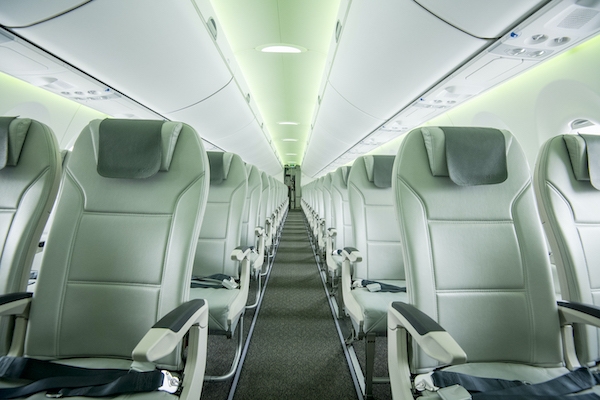
airBaltic reports that as the Airbus A220-300 aircraft is now certified to operate up to 149 seats, the company’s fleet is undergoing gradual change in cabin configuration, unblocking additional seats that couldn’t be used previously.
Martin Gauss, Chief Executive Officer of airBaltic commented: “In late February we received our first airBaltic Airbus A220-300 aircraft which is certified to operate up to 149 seats. Until now we could use 145 seats on the aircraft, however, going forward also existing fleet will be adjusted to use the additional capacity, which will further drive efficiency of our operations.”
As of April 5, the company has changed the cabin configuration for the first five of airBaltic’s 33 Airbus A220-300 aircraft. airBaltic plans to unblock the additional seats on its entire fleet by summer 2023. Due to different seat configuration, first 20 aircraft will have 148 seats available, while the next 12 aircraft will have 149 seats. All aircraft to be delivered between 2022 and early 2024 are planned to have 148 seats.
Since May 2020, airBaltic operates all its flights with a single aircraft type – Airbus A220-300, thus minimizing the complexity and benefiting from the additional efficiency provided by the aircraft.
The Airbus A220-300 has performed beyond the company’s expectations, delivering better overall performance, fuel efficiency and convenience for both passengers and the staff. This aircraft offers an excellent flying experience with such benefits for passengers as wider seats, larger windows, more hand luggage space in the cabin, improved lavatories and much more.
The Airbus A220-300 has a high-quality air filtering system equipped with High Efficiency Particulate Air (HEPA) type filter that provides the best level of filtration currently available for recirculated cabin air from the very beginning of boarding, during entire flight and until all passengers have left the aircraft. The quality of cabin air is carefully controlled and is recirculated with ventilation rates that provide a total change of air 20-30 times per hour.
In addition, the new aircraft is also considerably quieter – with a four times smaller noise footprint. Moreover, at the moment it is the greenest commercial aircraft in the world, as it is the first aircraft to have a transparent declaration of the life-cycle environmental impact, helping to reduce CO2 and NOX emissions by 20% and 50% respectively.

The Board of Directors of Costruzioni Aeronautiche Tecnam S.p.A. has unanimously appointed Giovanni Pascale Langer as Chief Executive Officer, while Paolo Pascale Langer, who...
International air charter specialist Chapman Freeborn has joined BlackBook Motorsport, the global business network connecting key stakeholders across Formula 1, NASCAR, MotoGP and the wider internatio...
Marking a significant industry milestone, Garmin has delivered its 1,000th G1000 integrated flight deck retrofit for a King Air aircraft. The program has helped redefine cockpit modernizatio...
From Learjets and Challengers to turboprops such as the Pilatus PC-12, different aircraft bring different capabilities to a medical flight. Sebastian Demiet, COO of MTI 24/7, explains why aircraft sel...

