



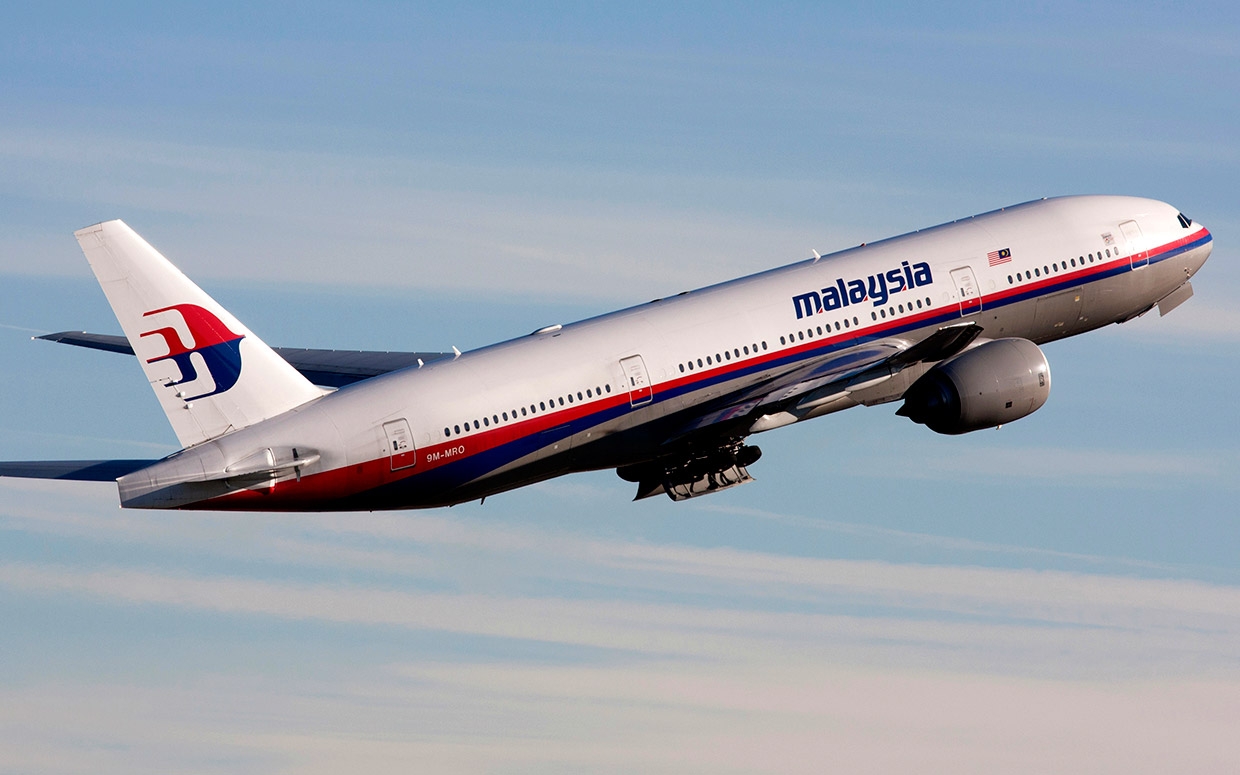
On October 13th 2015 representatives of Almaz-Antey Concern held a press-conference and presented results of their experiments carried out in order to simulate the crash of Malaysian Boeing 777, which happened in July 2014 in Ukraine.
The experiments carried out by Almaz-Antey proved that the Malaysian Boeing 777 was shot down by 9M38 missile, which was launched from Zaroschenskoye settlement instead of Snezhnoye settlement as declared before. It was stated by Almaz-Antey CEO Yan Novikov.
He stated that the press-conference was a starting date for the concern, because the international commission announced the final results of its investigation the same day. “On June 2nd we held the first press-conference and started preparation for two experiments, because we understood that investigators will not consider our results,” Novikov said.
He noted that outdated Russian-produced Il-86 aircraft was used for carrying out the experiments, because it has dimensions and design similar to Boeing 777. There are no B777 jets, which were put out of service, and it is too expensive to purchase a new jet for the experiments. Representatives of the concern noted that the total costs connected with the experiments amounted to 10 million rubles.
In his own turn, Advisor to Almaz Antey General Designer, Mikhail Malishevskiy, analyzed the shortcomings of simulation carried out by Dutch specialists. “The major proof of the fact that the jet was shot down from Snezhnoye was the simulation of this process and explanation of the nature of damage sustained by the aircraft. It may really demonstrate that a certain part of the aircraft sustains damage in case of approach of a missile on a collision course; however, this simulation doesn’t really show real approach angles,” Malishevskiy said. He also noted that Dutch investigators of Boeing 777 crash in Ukraine presented two types of destructive fragments, found in the body of the aircraft, while Almaz-Antey experiments confirmed that the jet’s body was damaged by three groups of the missile’s destructive fragments.
“Today we are confident: if the Boeing 777 was shot down by Buk air defense system, it was hit by 9M38 missile launched from Zaroschenskoye settlement. Simulation of the crash of the Malaysian Boeing 777 showed that if the missile was launched from Snezhnoye settlement (as stated by the Dutch experts), the jet’s left side, damaged during the crash, wouldn’t have been damaged by the missile’s destructive fragments,» Mikhail Malishevskiy.
Moreover, according to the concern’s representatives, production of 9M38 missiles was ceased in 1986 and in 2011 missiles of the type were put out of service in Russia. According to Yan Novikov, Boeing 777 could not be hit by state-of-the-art 9M38M1 missile, because this type of missiles leaves damage in the form of butterfly on an aircraft’s body, because out of 7000 destructive fragments, every fourth one has a double-T profile with the maximum momentum. Such “butterflies” were not found on the body of the Malaysian aircraft.
Desert Jet has broken ground on its long-planned ramp expansion at Jacqueline Cochran Regional Airport (KTRM), advancing a key infrastructure investment designed to accommodate rising business av...
Airbus has secured 21.J Civil Design Organisation Approval from Australia’s Civil Aviation Safety Authority (CASA), marking a significant milestone for its local operations and enhancing its abi...
Deutsche Aircraft is advancing the next chapter of regional aircraft manufacturing in Europe with the construction of a new production facility at Leipzig/Halle Airport. To support the site's...
EVIA AERO and Fabspace Hangars are addressing one of aviation’s most pressing infrastructure challenges: the shortage of hangar capacity across Europe. Through their partnership, EVIA AERO now o...

