



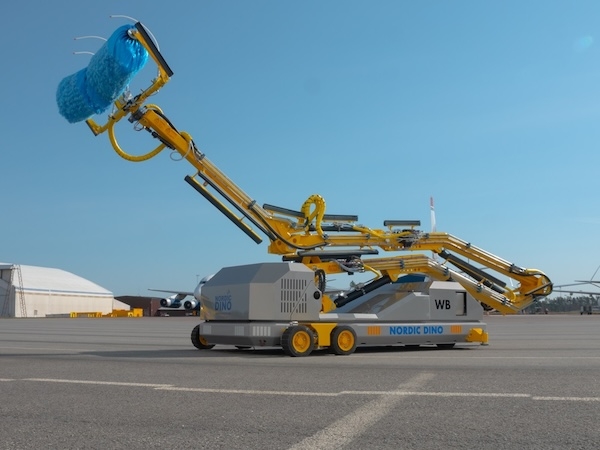
Aircraft cleaning presents numerous challenges for airlines, from dealing with environmental factors to ensuring efficiency and sustainability. And whether the temperature outside is sub-zero or the airfield is exposed to a sandstorm, the aircraft needs to be cleaned. Automated systems, like those from Nordic Dino, provide a versatile and effective solution to the many challenges airlines face.
Environmental challenges
It is clear that different climates and environments pose unique challenges to maintaining aircraft cleanliness:
Sandy Environments: Desert areas expose aircraft to sand, causing abrasive wear and tear. Frequent and thorough cleaning is necessary to maintain the aircraft's condition. This regular cleaning protects the aircraft’s paint and components from abrasive damage.
Salty Environments: Coastal regions expose aircraft to salt, which can be highly corrosive. Just as with the accumulation of sand, regular cleaning is essential to prevent damage from the accumulation of salt. Veronika Andrianovaite, CCO of Nordic Dino Robotics AB, states, "Like with sand, regular cleaning in salty environments is crucial to maintain aircraft integrity and protect against corrosion."
Cold Climates: In colder regions, using water for cleaning can be hazardous due to freezing temperatures. Still, Andrianovaite says, “While automated systems are mainly used in the warmer months, they still offer significant benefits during operational periods.”
Reducing environmental impact
Traditional aircraft cleaning methods often involve extensive use of water and detergents, leading to environmental waste and higher costs. Automated systems, on the other hand, use a mix of 90% water and 10% detergent, significantly reducing detergent usage and minimizing ecological impact.
Andrianovaite explains, "With the robot, we use significantly less detergent, which is both cost-effective and environmentally friendly. For example, some airlines used to apply 100% detergent manually, which was expensive and wasteful. Our system uses a controlled mixture that greatly reduces this waste."
Enhancing efficiency
Manual aircraft cleaning is labor-intensive and time-consuming. For wide-body aircraft, it can take up to 20 personnel and several hours. Automated systems drastically reduce cleaning time, allowing for quicker turnaround and improved operational efficiency.
"Manually, people can wash a wide-body aircraft in 8 to 10 hours. With the robot, we can reduce that time to 3 to 4 hours, saving a lot of ground time," Andrianovaite points out. This reduction in ground time is crucial for airlines, as it directly impacts their operational efficiency and profitability.
Versatility of automated systems
Automated cleaning systems are designed to work efficiently across various climates and conditions. They can adapt to the needs of different environments, ensuring thorough and effective cleaning. This versatility is key to their success.
In sandy and salty environments, frequent cleaning is essential to protect the aircraft's paint and components. Andrianovaite states, "Our robots help maintain the aircraft by providing regular, thorough cleanings that manual methods can't match."
Additional practical benefits
Automated cleaning systems provide benefits beyond just improved cleaning. Workers appreciate the ease of use and reduction in physical strain. Initial concerns about job impacts often dissipate when the advantages of improved working conditions and efficiency are realized.
Andrianovaite explains, "When workers see the robot's results, they realize it improves their working conditions without threatening jobs. Union representatives often see it as a tool to enhance work conditions, not as a threat to employment."
Client showcase
One of Nordic Dino’s clients, a major European airline, faced challenges with manual cleaning, particularly appreciated the reduction in physical strain and improved efficiency. "They have 60 to 70 people involved in the washing process. The unions initially feared job losses, but after seeing the robot in action, they recognized its benefits in improving working conditions," says Andrianovaite.
Automated aircraft cleaning systems address the multifaceted challenges of aircraft maintenance, offering a universal solution that enhances efficiency, reduces environmental impact, and adapts to diverse conditions. These systems demonstrate the potential for innovation in aviation, providing cleaner, safer, and more reliable operations.
Air Tahiti has received a new ATR 72-600 equipped with ATR’s HighLine All-Business Class cabin, becoming only the second airline worldwide to introduce this premium configuration on an ATR aircr...
Airbus has secured 21.J Civil Design Organisation Approval from Australia’s Civil Aviation Safety Authority (CASA), marking a significant milestone for its local operations and enhancing its abi...
Responding to rising customer interest in always-on, high-speed connectivity, Duncan Aviation has placed a prepaid order for 40 Gogo Galileo HDX systems, marking Gogo’s biggest MRO agreement thi...
Deutsche Aircraft is advancing the next chapter of regional aircraft manufacturing in Europe with the construction of a new production facility at Leipzig/Halle Airport. To support the site's...

