



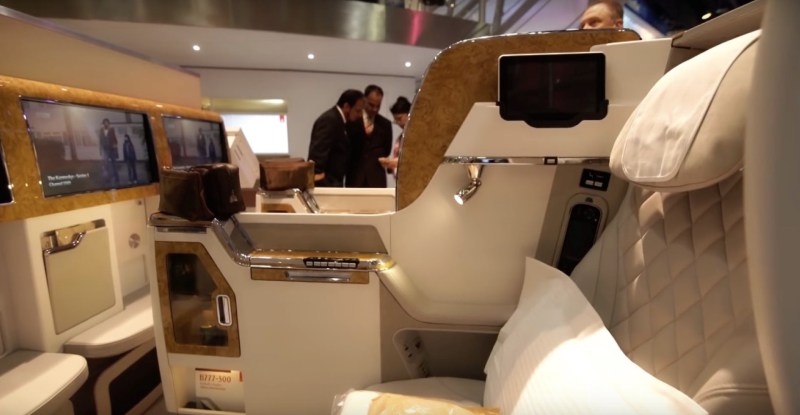
Emirates did make the 2-3-2 business class mistake with its new Boeing 777 seats I was worried about a couple of months ago, but at the Arabian Travel Market the airline revealed a few more interesting details about this seat, which “will make its debut on Emirates’ new Boeing 777-300ER aircraft deliveries starting November 2016″.
“The design and shape of this seat is inspired by the interior of a modern sports car,” an Emirates flight attendant says, demonstrating the seats. “As you can see from the diamond patterned stitching and the light grey leather, it looks very sleek.”
This ‘looks like a sports car seat’ seems to be a thread throughout Emirates’ marketing of its new product. A cynical observer might suggest that this is to distract from the 2-3-2 configuration, and indeed the very short pitch — “our new seat has a pitch of 72 inches and converts into a bed”, the flight attendant confirms, but that means the bed is under six feet long.
That’s six feet from one point on the seat to the same point on the seat in front or behind it, which means that the shell thickness is taken out of the bed length. And with relatively narrow seats at 2-3-2, this isn’t one of those seats where taller passengers can lie diagonally to gain extra space.

In an odd juxtaposition, the privacy panel raises and lowers, seemingly by a few inches, which adds complexity, weight, and is only relevant to the very tall passenger, who Emirates is not serving particularly well with the length of the seat.
“We have a USB port to charge your electronic devices,” the flight attendant continues, and an HDMI port so you can stream content from your personal device onto the IFE screen.”

In all my years of travelling, I have never seen anyone other than a fellow journalist testing the system try to hook up a device to an IFE screen. HDMI is probably the best choice for this, but that presumes 1) passengers are travelling with laptops, because iPad-to-HDMI requires a double-cable solution, and 2) that those laptops are laptops where the passenger has the ability to download content, and has had the chance to do so on a fast enough connection to pull down high enough definition video that it will look halfway decent on the screen. And of all the airlines to try this, it seems odd that Emirates, with its plethora of globally sourced content, would be the one.

The seat also has a minibar, matching the A380 offering in this small way, yet I feel that the purpose of the minibar, every time I’ve ever used one on a flight, is to bag a little bottle of water or a can of diet coke for the ride into town from the airport or for the next morning.
“Most importantly, we have one of the largest TV screens at 23 inches,” the flight attendant says at one point, going on to extol the virtues of Emirates’ ice IFE system, which is indeed excellent.
She also finishes up with “we hope our customers enjoy the product as well as the experience.”
That all leads me to the conclusion that this feels like the space optimisation and the bread-and-circuses approach to economy class — in other words, cram ‘em tight, make the experience exciting, and keep ‘em happy with IFE — trickling upwards to business class.
NetJets is elevating its premium ground experience with the introduction of new exclusive-use private terminals at Dallas Love Field (DAL), Washington Dulles International Airport (IAD) and Colorado&r...
Deutsche Aircraft is advancing the next chapter of regional aircraft manufacturing in Europe with the construction of a new production facility at Leipzig/Halle Airport. To support the site's...
Airbus has secured 21.J Civil Design Organisation Approval from Australia’s Civil Aviation Safety Authority (CASA), marking a significant milestone for its local operations and enhancing its abi...
Embraer and LATAM Airlines Group have signed a Component Pool Program agreement to support the airline's introduction of 24 Embraer E195-E2 aircraft. In addition to the firm order, LATAM retains o...

