



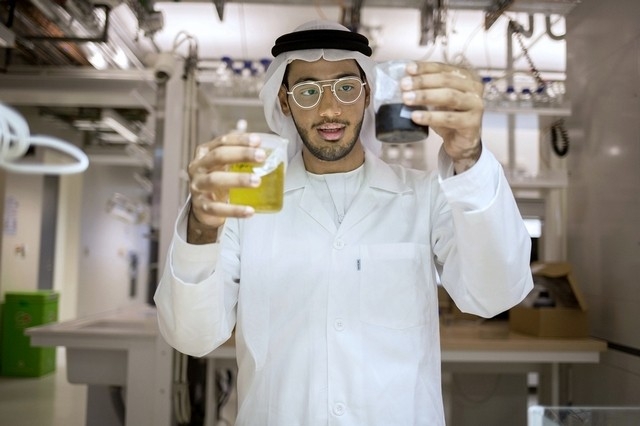
Students at the Masdar Institute are helping the country’s oil and gas sector tap the fuel potential of Abu Dhabi’s mangroves.
Mohamed Rashid Al Ghailani, 23, of Oman, is a postgraduate student taking part in the institute’s integrated seawater energy and agriculture system (Iseas) project.
“Iseas is a system where we produce food as well as biofuels and other marketable products,” said Mr Al Ghailani.
Biofuels are made from plant extractions, or biomass, and can be used in transport sectors such as aviation or ground transportation.
The team at Masdar Institute decided to test halophytes, an indigenous plant species that includes mangroves, as it does not grow on land that can be used for agriculture.
This is not the first such system in existence.
Carl Hodges, founder of the Environmental Research Laboratory at the University of Arizona, also created the US-based Seawater Foundation in the late 1970s to help poor areas use untreated seawater for irrigation and aquaculture farms.
“My focus is whether we can extract other high-value products from the plant before we proceed with the processing of biofuels and bioethanol,” said Mr Al Ghailani.
The master’s student said that one member of the team was already producing cosmetics from the extractives. “What I’m looking at, since my background is oil and gas, is chemicals that can also be used in the petroleum refining industry,” he said, adding that the pilot project should be completed by the end of the year. “If everything goes well, we will have a much larger facility in the future.”
New refining methods, involving speciality catalysts, in the hydrocarbon sector are imperative as the age of “easy oil” is past, according to industry experts. “People think that Masdar Institute and renewables contradict oil and gas, but they actually don’t,” said Mr Al Ghailani. “What I’m trying to do – based on my background in oil and gas plus interest in renewable energy – is merge the two.”
He said that the first question was always how much a project or technology costs.
“Right now, what we are doing is growing a plant using seawater in the desert to produce fuels. We are trying to reduce as much of the costs as we can to come out with something useful that wouldn’t have otherwise been used.”
EBAA France, the representative body for France’s business aviation ecosystem, brings together aircraft operators, airport activities, aircraft manufacturing, maintenance, and training providers...
From Learjets and Challengers to turboprops such as the Pilatus PC-12, different aircraft bring different capabilities to a medical flight. Sebastian Demiet, COO of MTI 24/7, explains why aircraft sel...
NetJets is elevating its premium ground experience with the introduction of new exclusive-use private terminals at Dallas Love Field (DAL), Washington Dulles International Airport (IAD) and Colorado&r...
Information Design One AG, the Frankfurt-based aviation technology company behind the aFuel platform, has achieved a major operational milestone. During the first half of 2026, aFuel processed 50...

