



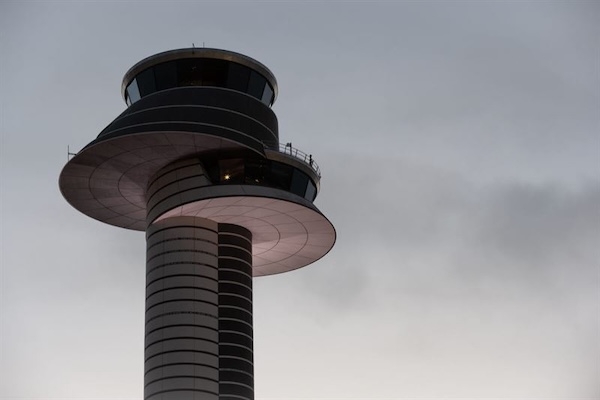
Swedavia and Luftfartsverket are the first in Europe to introduce a new air traffic approach concept. The new concept is commonly referred to as Established on RNP and makes it possible for aircraft arriving at Stockholm Arlanda Airport to fly with curved approaches to a greater extent than before. The concept is an important step towards increasing the capacity, efficiency and sustainability of air traffic.
Susanne Norman, Director of Operations at Swedavia commented: “For us, it is of course gratifying that Swedavia will be the first in Europe to apply the new concept for managing arrivals. Enabling more curved approaches is also the most effective way to support airlines in their transition work, in addition to facilitating increased use of sustainable aviation fuel.”
Anna Granberg, Director of Operations at Luftfartsverket stated: “The modernization of the airspace by Luftfartsverket shows how air traffic control can help reduce the environmental impact of aviation. The traffic flow into Stockholm Arlanda Airport becomes more efficient during peak hours, and arriving aircraft have shorter flight paths with reduced emissions."
The new approach concept allows the airport to increase the landing rate per hour and reduces emissions, both for the aircraft flying the shorter, curved approach and for those flying the standard instrument landing approach. This is because fewer aircraft have to use the runway dedicated for arrivals, reducing the queue for that runway. To be able to fly curved approaches, airlines must have a special permit from their National Supervisory Authority.
Charlotte Holmbergh, Country Director Corporate Affairs at Norwegian said: "We are very pleased with the initiative from Swedavia and the Swedish Air Traffic Control Provider (LFV) to implement new procedures that will increase the number of curved approaches (RNP AR – Required Navigation Performance, Authorization Required) at Arlanda. We would like to commend them for this effort and for the excellent cooperation we have had throughout the project. Shorter approaches result in lower fuel burn and reduced emissions. Our goal is to reduce emissions by 30 percent by 2030, and more efficient flight operations like this are among our top priorities — alongside increased use of sustainable aviation fuel and continuous fleet renewal."
Alexandra Lindgren Kaoukji, Head of External Communication & PR at SAS added: “SAS welcomes all initiatives that help reduce fuel consumption, noise, and emissions. The introduction of the new approach concept is a step in the right direction towards a more efficient and more sustainable airspace around Arlanda.”
The technique for curved approaches requires special equipment in the aircraft, specially trained pilots and special permission from their National Supervisory Authority. In addition to reducing the environmental impact, the introduction of the new approach concept also provides an incentive for airlines to invest in technique for curved approaches which, in the long run, makes it possible to avoid flying over noise-sensitive areas.
From Learjets and Challengers to turboprops such as the Pilatus PC-12, different aircraft bring different capabilities to a medical flight. Sebastian Demiet, COO of MTI 24/7, explains why aircraft sel...
The Board of Directors of Costruzioni Aeronautiche Tecnam S.p.A. has unanimously appointed Giovanni Pascale Langer as Chief Executive Officer, while Paolo Pascale Langer, who...
Desert Jet has broken ground on its long-planned ramp expansion at Jacqueline Cochran Regional Airport (KTRM), advancing a key infrastructure investment designed to accommodate rising business av...
Information Design One AG, the Frankfurt-based aviation technology company behind the aFuel platform, has achieved a major operational milestone. During the first half of 2026, aFuel processed 50...

