



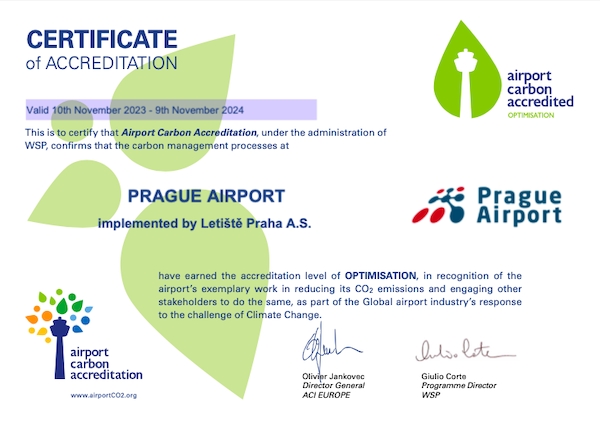
Prague Airport continues to reduce carbon dioxide emissions. Last year, 59.45% of CO₂ emissions were saved compared to 2009, when the airport first calculated its carbon footprint. After a year, the airport defended the Airport Carbon Accreditation Level 3, involving third parties, namely airlines, tenants, service providers, and others. The certification process also included verification of the carbon footprint by an independent auditor.
Soňa Hykyšová, Prague Airport Environmental Protection and ESG Director, commented: “Last year, for the first time, we adopted a long-term commitment to purchase green electricity in the proportion of 60%, with a gradual increase until 2030. We launched operations of the first photovoltaic power plant at the airport, located at Terminal 3. We purchased Dacia Spring electric cars and will continue purchasing electromobiles. We also continue replacing the existing lights with new energy-saving LED lighting and closely follow the development in the field of alternative fuels – both sustainable aviation fuel and hydrogen.” Prague Airport has been reducing emissions by an average of three to five thousand tons of CO2 annually.
Prague Airport wants to reach carbon neutrality by 2030 and net carbon neutrality by 2050. However, as many as 85 percent of airport emissions are generated by third parties – that is, suppliers and airlines. Therefore, the airport motivates them to reduce emissions in different ways. Prague Airport organizes the TOP Sustainable Airline contest for carriers, in which, alongside noise and emissions, the entire airline’s approach to sustainability is monitored. Air carriers are thus motivated to deploy new, modern aircraft with lower emission and noise pollution levels on routes to Prague. Emissions are also saved thanks to the change in departure procedures implemented during the COVID-19 pandemic. The specific approach to reducing CO₂ emissions in the long-term horizon will be published next year in the decarbonisation plan, which is currently being supplemented with planned investment actions and operational measures.
Subsidiaries also reduce emissions
Prague Airport’s subsidiaries have also taken measures to reduce CO₂ emissions. Czech Airlines Technics has replaced the lamps on Hangar F with LED lighting and at the same time purchases green electricity. The same approach was adopted by Czech Airlines Handling, which also uses electric ground support equipment (GSE) with a commitment of a 40 percent share in 2030.
Prague Airport employees are also motivated to reduce their carbon footprint, for example, as part of the Biking to Work initiative. The main goal of the Airport Carbon Accreditation programme is to support airport operators in their efforts to reduce greenhouse gas emissions from various airport activities. The programme brings together hundreds of airports around the world that map their carbon footprint and implement procedures to reduce it.
When a vehicle assembly line is at risk of running out of critical components, every minute of downtime carries a significant cost. In many cases, an emergency air charter is not the expensive option,...
From Learjets and Challengers to turboprops such as the Pilatus PC-12, different aircraft bring different capabilities to a medical flight. Sebastian Demiet, COO of MTI 24/7, explains why aircraft sel...
Airbus forecasts that demand for aviation services will more than double between 2026 and 2045, exceeding US$420 billion in value. Driven by a compound annual growth rate (CAGR) of 3.8%, the sector wi...
NetJets is elevating its premium ground experience with the introduction of new exclusive-use private terminals at Dallas Love Field (DAL), Washington Dulles International Airport (IAD) and Colorado&r...

