



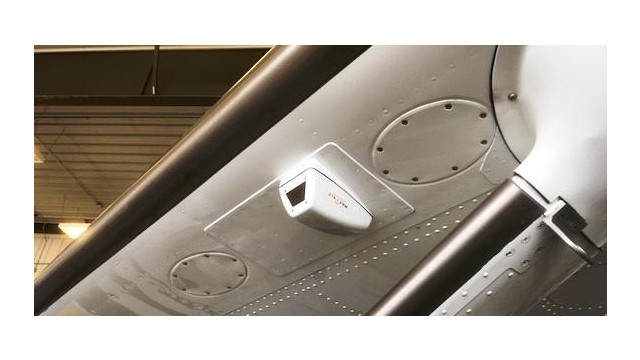
Astronics Corporation through its wholly-owned subsidiary Astronics Max-Viz, announced that its Max-Viz 1400 Enhanced Vision System (EVS) for fixed and rotor wing aircraft has been certified to DO-160G standards by the Radio Technical Commission for Aeronautics (RTCA). DO-160G is the industry standard for the environmental testing of avionics hardware and is recognized by the International Organization for Standardization (ISO) as de facto international standard ISO-7137.
"This additional level of environmental compliance is further testament to the ruggedness and reliability of the Max-Viz 1400 EVS," said Elliott Troutman, Astronics Max-Viz Executive Vice President. "The Max-Viz 1400 meets or exceeds RTCA standards to include resistance to temperature, altitude, humidity, shock, vibration, water, sand and dust, fungus, magnetic effect, power spikes, audio and radio frequencies, lightening, icing and flammability."
The Max-Viz 1400 EVS is a lightweight, solid state, low power system with a high resolution 640x480 uncooled thermal detector. The sensor image can be presented on any video-capable display that accepts Composite video (RS-170) NTSC or PAL/Analog signals. The one and a half pound system features a digital image zoom capability, integral window heaters for operations from -55 to +70 degrees Celsius and pixel nonconformity correction.
The Max-Viz infrared enhanced vision system detects the differences in heat of objects and terrain in an airplane's environment, producing an accurate real-time picture of the surroundings in the absence of visible light. With thermal imaging, the EVS display enables pilots to see when flying day or night in smoke, haze, and light fog. The EVS can work as an alternative to, or in tandem with, light-based night-vision goggle technologies.
The Max-Vix 1400 EVS complements synthetic vision displays, allowing pilots to see transient obstructions, like wildlife and construction barriers not in synthetic vision databases. The system gives real time confirmation of the operating environment, as well as supporting the approach to landing transition from Instrument Flight Rules to Visual Flight Rules in marginal visual conditions.


Bombardier will return to the 2026 NBAA Business Aviation Convention & Exhibition with a showcase that highlights the company's flagship aircraft, award-winning customer support network and di...
Viasat, a global leader in satellite communications, has enhanced its JetXP business aviation connectivity service with a simplified three-tier plan structure and, for the first time, publis...
AeronautX, part of the AX Aero Group, has announced the launch of a new business aviation pilot training centre in Amsterdam, scheduled to open in the first quarter of 2027. Created by business a...
Embraer and LATAM Airlines Group have signed a Component Pool Program agreement to support the airline's introduction of 24 Embraer E195-E2 aircraft. In addition to the firm order, LATAM retains o...

