



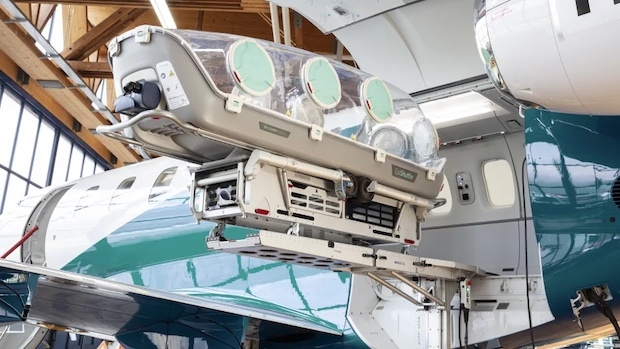
The global COVID-19 pandemic situation has fueled a growing demand for air transport solutions for infectious patients. To prevent in-flight transmission of viruses to cockpit and cabin crew, infected individuals are transported in an isolation unit known as an EpiShuttle. With its large cargo door and complete air ambulance equipment, the PC-24 is ideally suited for these missions.
– We are glad to see that Pilatus offers the very best patient comfort and safety. With the EpiShuttle’s features of reclinable backrest, transparent hard-top and excellent patient access, their passengers, both patient and staff, will have a safer and better ride. We are also impressed by Aerolite’s ingenuity when integrating the EpiShuttle into the medevac PC-24, an excellent aircraft for the transfer of infected patients with the EpiShuttle, says Ellen Cathrine Andersen, CEO in EpiGuard.
Medical Isolation
In 2015, during an outbreak of Ebola in Africa, Norway’s EpiGuard developed a modular isolation system which is now also in use for Covid-19 missions. The EpiShuttle features a modular reusable design and eight medical airlocks to ensure safe patient handling.
Development Partner Aerolite
Together with its development partner, Aerolite AG, Pilatus now offers integration of the EpiShuttle in medevac PC-24s. Using an adapter, the EpiShuttle is attached to a universal transport trolley allowing transfer movements on the ground and positioning in the cabin. Loading is performed with the unique loading device, which automatically transfers the EpiShuttle unit plus patient into the cabin. The completely flat cabin floor and rollers on the transport trolley ensure the unit can be freely pushed into the desired position, where it is then secured directly to the seat rails using retaining devices.
Patient monitoring is ensured by medical equipment placed on a cradle right next to the EpiShuttle and powered by the on-board power supply. As with regular patient transport operations, medical personnel occupy cabin seats in the immediate vicinity of the EpiShuttle, and can attend to the patient at any time.


From Learjets and Challengers to turboprops such as the Pilatus PC-12, different aircraft bring different capabilities to a medical flight. Sebastian Demiet, COO of MTI 24/7, explains why aircraft sel...
EVIA AERO and Fabspace Hangars are addressing one of aviation’s most pressing infrastructure challenges: the shortage of hangar capacity across Europe. Through their partnership, EVIA AERO now o...
The Board of Directors of Costruzioni Aeronautiche Tecnam S.p.A. has unanimously appointed Giovanni Pascale Langer as Chief Executive Officer, while Paolo Pascale Langer, who...
Air Tahiti has received a new ATR 72-600 equipped with ATR’s HighLine All-Business Class cabin, becoming only the second airline worldwide to introduce this premium configuration on an ATR aircr...

