



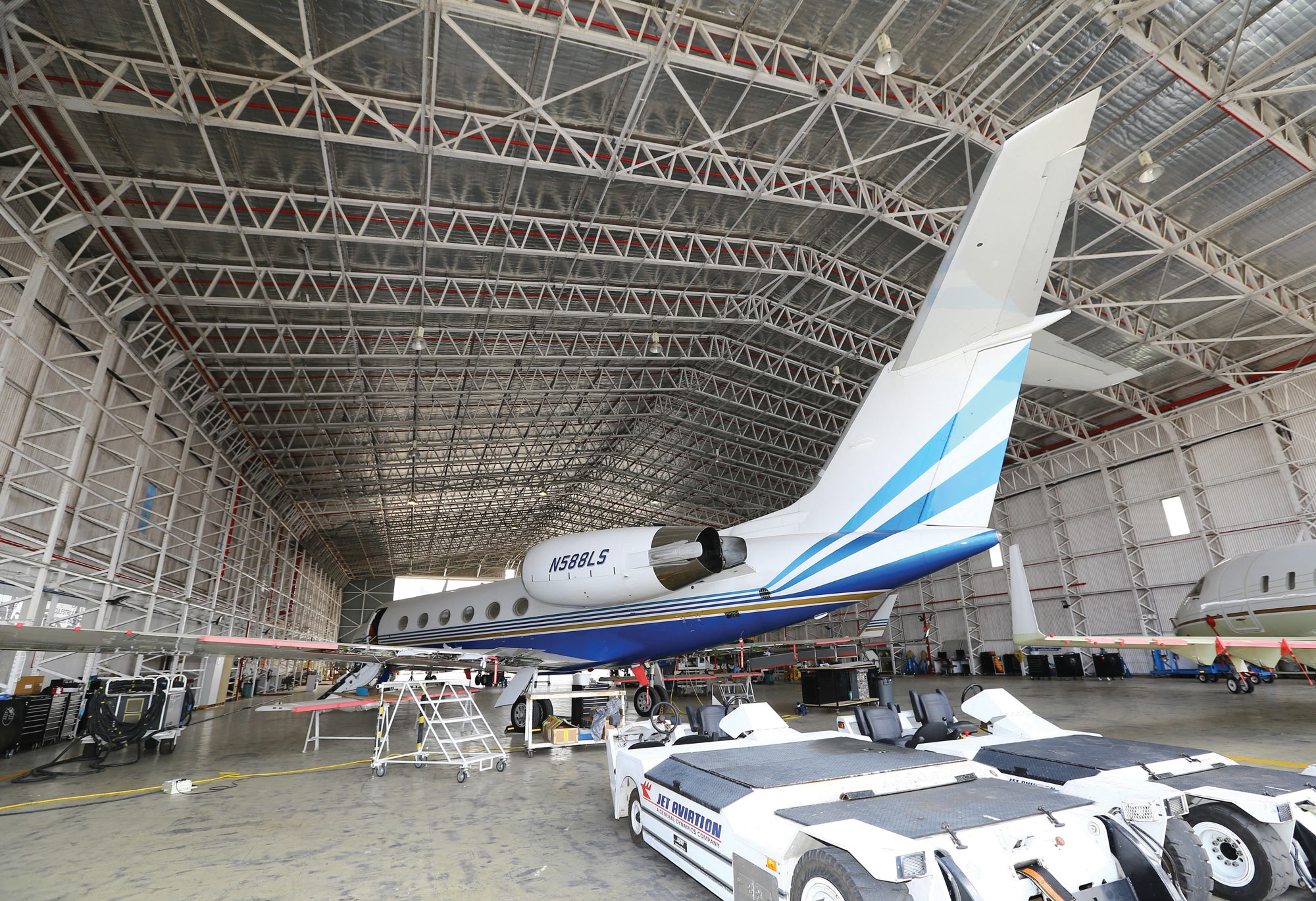
Singapore has achieved its status as a business aviation hub because of its central geographic location and the fact that it draws on business aviation customers from the surrounding countries, says Hawker Pacific VP Asia, Louis Leong.
Leong says another advantage Singapore has is that many of the engine and component makers have overhaul facilities there. This helps MRO companies such as Hawker Pacific because rather than having to send the engines or special components overseas to be overhauled, the work can be done in Singapore. This saves time and money.
At the 2014 Singapore Airshow,Bombardier officially opened its MRO facility at Seletar, which supports the Challenger, Global Express and Learjet range of aircraft. Bombardier Customer Services VP for aircraft service centers Stan Younger says the facility now employees 90 people and soon will have more than 100.
Younger says Bombardier chose Singapore because of its central location and its “business friendly” environment. He says people generally like visiting Singapore and it has a good reputation, so it is not too difficult convincing customers to send their aircraft there to be worked on.
Richard Porter, ExecuJet business development manager for Asia, says business aircraft are valuable assets that need to be properly managed and maintained. He says where an aircraft is maintained can impact its residual value.
The fact that Singapore has a good reputation as a center for MRO helps, he says. Many aircraft owners and financiers also like to do aircraft transactions in Singapore because the city-state has a strong judicial system.
Porter says the business aviation sector in Asia is going through a very difficult period and this is compounded by the fact that many Asian currencies, such as the Indonesian rupiah and Malaysian ringgit, have depreciated greatly against the U.S. dollar.
He says businesspeople whose wealth is derived from commodities are the most adversely affected. But those businesspeople with a more-diverse business portfolio, in other sectors of the economy, are less affected.
Porter also says the longer-term prospect for the industry remains strong. And the fact that there are so many new models of aircraft coming onto the market, such as the Gulfstream G650ER and Dassault Falcon 8X, will generate excitement and interest in the category, he adds.
While business aviation companies that ShowNews spoke with were generally very positive about what Singapore has achieved in the business aviation sector, the general consensus is that more still needs to be done at Seletar Aerospace Park.
A key issue holding back Seletar Aerospace Park is a lack of parking space for aircraft. Jurong Town Corp., which is responsible for developing and managing Seletar, has increased the amount of parking space available, but business jet operators say it is still insufficient.
“We don’t have enough parking space,” says Hawker Pacific’s Leong, adding that if this issue remains unresolved, it will end up driving business away.
In Singapore, land is valuable. Industry executives say the authorities have a policy of only allocating land at Seletar Aerospace Park to businesses that demonstrate that the new facility will employ 100 people or more and that many of the jobs will be highly skilled, high paying jobs. Building hangars at Seletar to park business jets is less of a priority, as it generates very few jobs, they say.
But if there is nowhere to park your business jet, it puts a damper on Singapore’s efforts to remain a business aviation center in the region. Some business jet owners want to park their aircraft in a hangar, because it helps protect it from the elements, such as tropical storms and salt in the air.
And the fact that Singapore is a major business center in the region means that business aviation traffic will continue to increase. Changi Airport Group, which manages Changi and Seletar Airport, says business aviation traffic in Singapore has been achieving compound annual growth of 14%.
Bombardier forecasts that from 2015-2024 there will be 875 business aviation aircraft delivered to Greater China, 355 to the Asia-Pacific region (excluding Greater China and India) and 310 to South Asia, including India.


AERO 2027 will place an even stronger spotlight on the helicopter sector, building on the momentum and success of AERO 2026, organisers Fairnamic announced today. As Europe’s leading trade fair...
The Board of Directors of Costruzioni Aeronautiche Tecnam S.p.A. has unanimously appointed Giovanni Pascale Langer as Chief Executive Officer, while Paolo Pascale Langer, who...
Deutsche Aircraft is advancing the next chapter of regional aircraft manufacturing in Europe with the construction of a new production facility at Leipzig/Halle Airport. To support the site's...
HondaJet Classic and APMG operators across the European Union can now access the latest enhancements developed for the HondaJet family following the European Union Aviation Safety Agency’s valid...

