



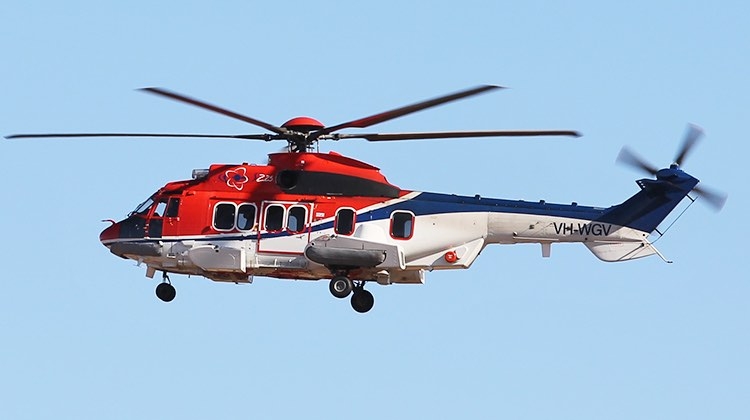
The Accident Investigation Board of Norway (AIBN) has determined the fatal crash of Airbus Helicopters H225 (EC225LP), LN-OJF, on April 29 near Turoy, Norway, was most likely caused by a fatigue fracture in one of the eight second stage planet gears inside the twin-engine helicopter’s main gearbox (MGB).
The AIBN’s most recent preliminary report which it released on June 28, its fourth since the investigation began, said the fracture propagated in a manner which was unlikely to become detected by existing mandatory or supplementary systems for warning of an imminent failure. The AIBN also said it considered it unlikely that the fatigue crack propagated as a consequence of a structural break-up of another component.
Further investigations by the AIBN since the release of its last preliminary report have determined the failure of a suspension bar attachment or failure of the MGB conical housing were not the initiating event that caused the rotor head to separate from the fuselage in-flight.
The AIBN reported it was aware LN-OJF’s MGB was involved in a road accident during transport in 2015. The MGB was inspected, repaired and released for flight by the manufacturer before it was installed on LN-OJF in January 2016. Whether there is a link between this event and the initiation and growth of a fatigue fracture is currently being investigated.
The accident involving LN-OJF and its findings to date are similar in circumstances to the fatal 2009 crash of an Airbus Helicopters AS332 L2, G-REDL, off the coast of Peterhead, Scotland where a fatigue fracture in the second stage planet gear in the epicyclic module caused the main rotor and part of the epicyclic module to separate from the fuselage. In that accident all 16 crew and passengers on board were killed when the fuselage impacted the water at high speed.
“We continue to focus our efforts on providing assistance to the investigation team and the authorities as they work toward the identification of the accident root cause,” said Airbus Helicopters in a statement.
“In parallel, we are putting precautionary measures in place to support our global customers and address potential initiating events.”
While the investigation is ongoing, and with some important components still missing, the AIBN said it will now seek to determine what initiated the fracture in the second stage planet gear and the mechanisms behind its growth.
HondaJet Classic and APMG operators across the European Union can now access the latest enhancements developed for the HondaJet family following the European Union Aviation Safety Agency’s valid...
Bombardier will return to the 2026 NBAA Business Aviation Convention & Exhibition with a showcase that highlights the company's flagship aircraft, award-winning customer support network and di...
Responding to rising customer interest in always-on, high-speed connectivity, Duncan Aviation has placed a prepaid order for 40 Gogo Galileo HDX systems, marking Gogo’s biggest MRO agreement thi...
Phenix Jet Cayman has added a Bombardier Global 8000 to its managed fleet, successfully completing the aircraft's CAACI registration transfer and entry into service in less than five business days...

