



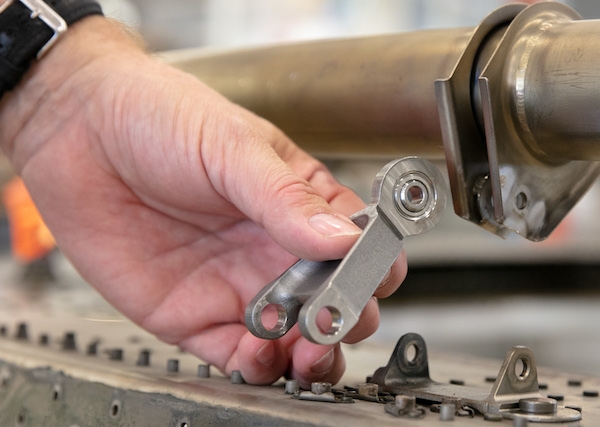
In their joint effort to use additive manufacturing methods for a more cost-efficient aircraft spare parts production, Lufthansa Technik and Premium AEROTEC recently reached an important milestone: A metal component developed at Lufthansa Technik's Additive Manufacturing (AM) Center for the IAE-V2500 engine's anti-icing system has now received its official aviation certification from EASA. On this basis, Premium AEROTEC will produce the so-called "A-Link" for Lufthansa Technik at its Varel (Germany) site using a 3D printer.
A total of nine of these A-Links fix a ring-shaped hot air duct in the engine's inlet cowl, which is thus protected from ice buildup during flight operations. However, the vibrations that occur here during operation cause the A-links to wear at their mounting holes, so that after a few years they are often ripe for replacement.

As the A-Links can be exposed to temperatures of up to 300 degrees Celsius, they are made of titanium. In the original, the component is manufactured by a forging process to meet the highest requirements for material properties. In the new manufacturing solution developed by Premium AEROTEC and Lufthansa Technik, however, it is built layer by layer in a 3D printer. This process, called Laser Power Bed Fusion (LPBF), offers the advantage over forging that no jigs or molds are needed for production. In addition, the process can save valuable material, since after 3D printing a material removal is only necessary to a very small extent on some functional surfaces.
However, the properties of the components produced in this way, for example their strength, are heavily dependent on the corresponding additive manufacturing process, the qualification of which must therefore be proven in a complex procedure. To this end, Premium AEROTEC carried out a large number of so-called "print jobs" with test specimens, with constant settings of all process-relevant parameters. This way, it was finally possible to establish a constant and reliable process and to prove that the highest requirements in terms of material properties are also achieved here. In terms of tensile strength, the additively manufactured A-Link is even superior to the original part.
As part of this certification process, Lufthansa Technik has now extended the expertise of its EASA Part 21/J development facility to include additively manufactured metal components. For Premium AEROTEC, the cooperation with Lufthansa Technik is a significant milestone in the field of additive manufacturing, as it is the first time the company has supplied a customer outside the Airbus Group with printed series components. The first A-Links from the cooperation will be used in the Lufthansa fleet, where long-term experience with the new components is to be gained beyond certification.
"Premium AEROTEC is an international pioneer and technology leader in the additive manufacturing of aerospace components. Our company has already been applying this technology in the series production of complex structural components since 2016," said Dr. Ulrich Weber, Chief Operating Officer at Premium AEROTEC. "I am very pleased that in cooperation with Lufthansa Technik we can now once again demonstrate our comprehensive expertise in 3D printing."
"We have been producing components for the aircraft cabin, the vast majority of which are made of plastic, using 3D printing for years. Now we are able to demonstrate that structurally relevant metal parts for use outside the cabin can also be manufactured additively and approved for flight operations," said Soeren Stark, Chief Operating Officer of Lufthansa Technik. "In this way, we have not only achieved a cost saving for the component in question, but also defined and qualified all the necessary processes for the application of this groundbreaking manufacturing method for structurally relevant metal parts."
However, the first aviation certification of a load-bearing metal spare part currently represents only a first step for both partners, as its geometry still largely corresponds to the original part. Future developments in the technology will also make it possible to use the advantages of additive manufacturing for targeted optimization of the geometry. Theoretically, there are no limits to the shaping of additively manufactured components, so that they can then be produced much more easily and with less material while retaining the same strength and function. Both partners intend to further develop these possibilities in the near future.
Information Design One AG, the Frankfurt-based aviation technology company behind the aFuel platform, has achieved a major operational milestone. During the first half of 2026, aFuel processed 50...
Deutsche Aircraft is advancing the next chapter of regional aircraft manufacturing in Europe with the construction of a new production facility at Leipzig/Halle Airport. To support the site's...
Embraer and LATAM Airlines Group have signed a Component Pool Program agreement to support the airline's introduction of 24 Embraer E195-E2 aircraft. In addition to the firm order, LATAM retains o...
Airbus forecasts that demand for aviation services will more than double between 2026 and 2045, exceeding US$420 billion in value. Driven by a compound annual growth rate (CAGR) of 3.8%, the sector wi...

