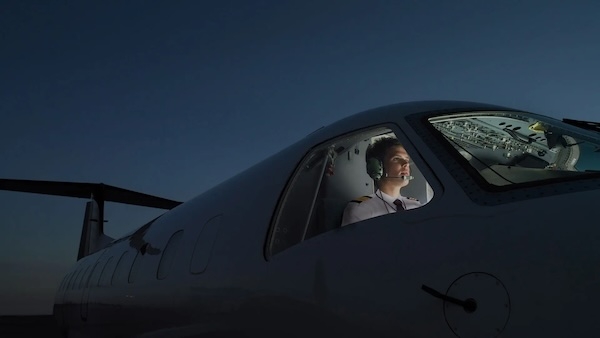
An estimated 1.5 million civil aviation professionals will be needed worldwide by 2034, according to CAE’s biennial Aviation Talent Forecast, released today at the Paris International Air Show. The comprehensive 2025 edition of the forecast analyzes the need for pilots, aircraft maintenance technicians, cabin crew, and, for the first time, air traffic controllers, predicting that 71,000 controllers will be needed globally over the next 10 years.
The 2025 CAE Aviation Talent Forecast reports that 1,292,000 commercial aviation professionals will be needed - 267,000 pilots, 347,000 aviation maintenance technicians, and 678,000 cabin crew - with the largest percentage required to meet rapidly rising demand in the Asia Pacific region. In addition, 102,000 business aviation professionals are expected to be needed worldwide over the next 10 years, including 33,000 pilots and 69,000 aircraft maintenance technicians.
Marie-Christine Cloutier, Vice-President – Strategy, Performance, Air Traffic Services & Marketing at CAE commented: “The need for 1.5 million new aviation professionals by 2034 is being driven by record demand for air travel and a significant wave of retirements that is expected across all categories. With commercial and business aviation fleets expected to see double digit increases over the next 10 years, the industry must take action to attract, train, and retain personnel. Highly skilled aviation professionals are not just a necessity for the safety of the air transport system, they are the foundation for the successful expansion and resilience of the global aviation sector. To meet the demand, the industry needs to be proactive and creative. Adaptability and optimized training will be key to supplying the demand. We need a comprehensive training environment that caters to the way new generations learn and thrive. At CAE, part of our solution is investing significantly in innovation and technology. Some of our latest advancements include CAE’s immersive pilot training app using Apple Vision Pro, and the CAE Prodigy Image Generator, our ultra-realistic 3D visual system using gaming technology."

Attracting talent is one challenge. Another is ensuring qualified candidates make it through graduation and into the workforce. Across all professions covered in the report, dropout and failure rates are higher than they should be. For example, in the United States alone, a staggering 30% of paid air traffic control students do not complete their training, according to the National Airspace System Safety Review Team.
The Aviation Talent Forecast is a strategic tool for stakeholders across the aviation ecosystem which analyzes the upcoming talent demand, the drivers behind that demand, and actionable strategies the industry can adopt to attract and retain talent. The report also offers insightful perspectives on the industry's transformation through advanced training, sustainable practices, and diverse talent acquisition. It also underscores how technology, sustainability, and diversity are shaping the future of the industry and strengthening the talent pipeline.
Archived
1 year ago
Desert Jet has broken ground on its long-planned ramp expansion at Jacqueline Cochran Regional Airport (KTRM), advancing a key infrastructure investment designed to accommodate rising business av...
EVIA AERO and Fabspace Hangars are addressing one of aviation’s most pressing infrastructure challenges: the shortage of hangar capacity across Europe. Through their partnership, EVIA AERO now o...
Bombardier will return to the 2026 NBAA Business Aviation Convention & Exhibition with a showcase that highlights the company's flagship aircraft, award-winning customer support network and di...
Information Design One AG, the Frankfurt-based aviation technology company behind the aFuel platform, has achieved a major operational milestone. During the first half of 2026, aFuel processed 50...