



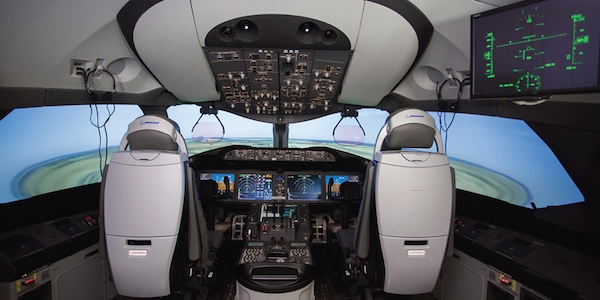
Etihad Aviation Training has become the first aviation company in the Middle East to gain approval from the European Aviation Safety Agency (EASA) to train Boeing 777 and 787 pilots for European operators and carriers elsewhere which adopt Europe’s air safety standards. The approval to train pilots for these two wide-bodied Boeing aircraft types expands the global capabilities of Etihad Aviation Training, which in 2018 also became the first Middle Eastern aerospace business to gain EASA designation as an Approved Training Organisation for pilots of Airbus A320, A330 and A340 aircraft.
Captain Paolo La Cava, Vice President and Managing Director of Etihad Aviation Training, said continuing growth in global demand for air travel was driving increased requirements for pilot training. “Some operators have insufficient capacity to conduct training in their own facilities while others do not have in-house capabilities,” said Captain La Cava. “In addition to training pilots for Etihad Airways, Etihad Aviation Training also supports the requirements of many other operators for a range of aircraft types.
The suite of offerings ranges from ‘ab-Initio’ courses to type rating and recurrent training, as well as Upset Recovery Training and Performance Based Navigation.
Etihad Aviation Training has 11 full motion training simulators, including five for Boeing 777 and 787 training, as well as fixed base devices, and training teams include senior pilots actively flying for Etihad Airways. Support options can also be provided, including accommodation, transport and even tourism for trainees in Abu Dhabi.
Captain La Cava said the Boeing 777 and 787 were two of the most in-demand aircraft in service today, and as their deployment increased so too did demand for pilot training. He said Etihad Aviation Training soon would also add training capability for the newest widebody aircraft in airline service, the Airbus A350.
“The EASA designation as an Approved Training Organisation for the Boeing 777 and 787 significantly broadens the markets in which Etihad Aviation Training can offer services, enabling the business to support operators in Europe and elsewhere, particularly in the fast-growing Asia region where EASA standards have been adopted,” said Captain La Cava. “This approval also strengthens the credentials of Abu Dhabi as an aviation centre of excellence for aircrew training and other services including maintenance and engineering.”
Desert Jet has broken ground on its long-planned ramp expansion at Jacqueline Cochran Regional Airport (KTRM), advancing a key infrastructure investment designed to accommodate rising business av...
MySky, the spend and revenue management platform trusted by operators of more than 2,000 business aircraft worldwide, announced the launch of MySky Pay at NBAA-BACE 2026, introducing a purpo...
EBAA France, the representative body for France’s business aviation ecosystem, brings together aircraft operators, airport activities, aircraft manufacturing, maintenance, and training providers...
Deutsche Aircraft is advancing the next chapter of regional aircraft manufacturing in Europe with the construction of a new production facility at Leipzig/Halle Airport. To support the site's...

