


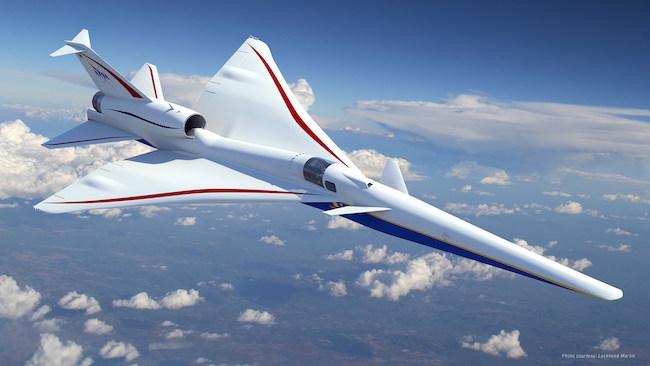
In line with its vision to redefine aerospace, Collins Aerospace has been selected by Lockheed Martin to provide avionics for the new X-59 Quiet Supersonic Technology (QueSST) aircraft. The X-59 is being developed by Lockheed Martin for NASA to collect data that could make supersonic commercial travel over land possible through low sonic boom technology. Collins Aerospace is a business unit of United Technologies Corp.
Collins will provide developmental engineering support to tailor its Pro Line Fusion avionics to the specific requirements of the X-59. By jointly developing software applications side-by-side, Lockheed Martin will receive an optimized solution which will also include Collins' award-winning touchscreen primary flight displays with tailored multi-function windows, head-up display (HUD) symbology, synthetic vision, ARC-210 communication radios, and a suite of navigation and surveillance equipment. Lockheed Martin will house a System Integration Lab for the Pro Line Fusion avionics at its facility in Palmdale, California.
In addition, Collins will provide a dual multi-spectral enhanced vision system (EVS-3600). In order to achieve supersonic speeds with a low sonic boom signature, the X-59 must have a long and slender shape. This shape also makes a forward-looking window impractical. The EVS-3600 will enable pilots to land in nearly all conditions using advanced visual sensors leveraging long wave, infrared technology.
"Our industry-leading avionics, combined with one of the most advanced EVS cameras in the market, will add to the safety and efficiency of this forward-leaning aircraft," said Dave Schreck, vice president and general manager for Military Avionics and Helicopters at Collins Aerospace. "We look forward to working with Lockheed Martin and NASA to play an integral role in making quiet supersonic travel over land possible for passengers."
The X-59, which is expected to take its first flight in 2021, is designed to create a sound about as loud as a car door closing, instead of a sonic boom. It will be used to collect data on the acceptability of the quiet sonic boom generated by the aircraft, helping NASA establish an acceptable commercial supersonic noise standard to overturn current regulations banning supersonic travel over land.
Gogo has unveiled its long-term vision for the Galileo connectivity platform at NBAA-BACE 2026, outlining a roadmap designed to enhance and protect customer investments well into the mid-2030s and bey...
Airbus 2026 Cargo Global Market Forecast, unveiled at the Cargo Facts Symposium, predicts that the global fleet of dedicated freighter aircraft will expand by 46%, rising from 2,360 aircraft in 2026 t...
Viasat has significantly expanded the capacity of its JetXP in-flight connectivity service across the United States, delivering up to five times more bandwidth for business aviation customers equipped...
In business aviation, exceptional service is defined by attention to detail, and few amenities reflect that more clearly than premium catering. At the intersection of hospitality and private aviation,...