



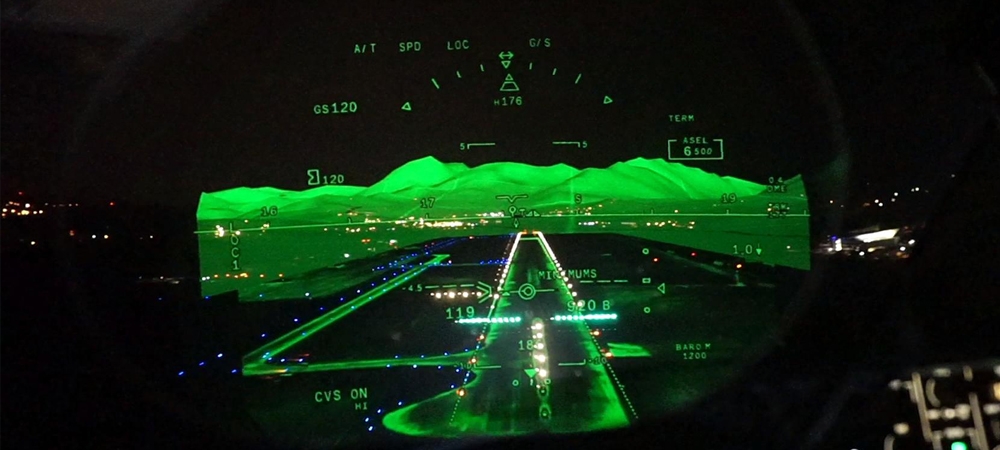

The Dassault Falcon 900LX, Falcon 2000LXS and Falcon 2000S have been certified by EASA and the FAA for an enhanced flight vision system (EFVS) capability that greatly improves access to airports in bad weather, providing operational credit for poor visibility approaches down to 100 ft.
The new EFVS capability, provided through Dassault Aviation’s revolutionary FalconEye Combined Vision System (CVS) and its unique combination of six fused sensors, was previously certified on the Falcon 8X ultra-long range trijet following the completion of joint EASA/FAA trials last year.
FalconEye is the first Head-Up Display (HUD) to show separate synthetic, database-driven terrain mapping and enhanced thermal and low-light camera images at the same time. It also allows pilots to adjust the split between synthetic vision system (SVS) and enhanced vision system (EVS) imaging areas to suit visibility conditions, providing an unprecedented level of situational awareness and allowing the crew to perform bad weather landings with much higher levels of confidence, precision and safety.

The FalconEye option has been available on the two-engine 2000LXS/2000S and the three-engine 900LX since October 2016 and on the Falcon 8X since early 2017. The system will also be available on the new Falcon 6X ultra widebody twinjet, which is due to enter service in 2022.
The next enhancement to the FalconEye option will be the addition of a dual head-up display configuration that will support an EFVS-to-land capability, allowing pilots to fly a full approach and land without requiring natural vision to see the runway. The full approval of this capability is anticipated next year.
The recent operational improvement to FalconEye and certification is part of a series of enhancements and new options designed to extend Falcon mission capability. Others include Dassault’s Falcon Sphere II integrated Electronic Flight Bag (EFB) suite and FalconConnect, a comprehensive package of broadband communications solutions designed to facilitate the use, management and control of inflight connectivity.



Embraer and LATAM Airlines Group have signed a Component Pool Program agreement to support the airline's introduction of 24 Embraer E195-E2 aircraft. In addition to the firm order, LATAM retains o...
Airbus forecasts that demand for aviation services will more than double between 2026 and 2045, exceeding US$420 billion in value. Driven by a compound annual growth rate (CAGR) of 3.8%, the sector wi...
HondaJet Classic and APMG operators across the European Union can now access the latest enhancements developed for the HondaJet family following the European Union Aviation Safety Agency’s valid...
AEE Aircraft Electronic Engineering GmbH and Horizon Aircraft have joined forces to integrate advanced avionics capabilities into the Cavorite X7 hybrid-electric eVTOL programme. Throug...

