


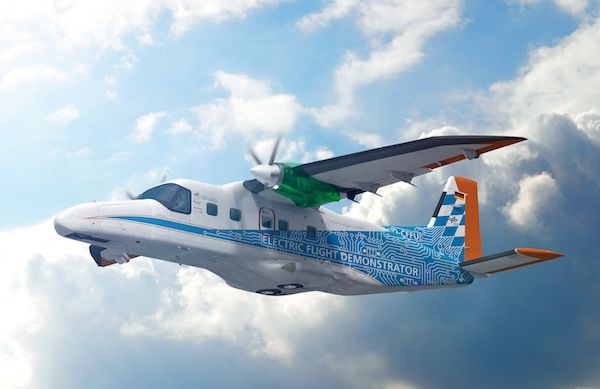
MTU Aero Engines has entered into an innovation partnership with the European Union Aviation Safety Agency. Together, the partners are investigating the potential ways forward for future certification of a flying fuel cell (FFC). The hydrogen-powered fuel cell is a very promising propulsion concept on the way to emission-free flying and an integral part of MTU’s Clean Air Engine (Claire) technology agenda. Safety is a top priority in aviation, which is why entirely new standards, approval regulations and verification procedures must be defined for the safe operation of the new propulsion concept of the flying fuel cell.
“When it comes to the approval of a flying fuel cell, all parties involved are entering uncharted territory,” explains MTU’s Head of Quality Thomas Frank, “which is why we are seeking dialog with the certification bodies at such an early stage.” In this way, he says, MTU is underscoring its pioneering role in this new technology. “We rely on a strong network of partnerships and research collaborations. Together with EASA, we are breaking new ground for a sustainable orientation of aviation,” adds Barnaby Law, Chief Engineer Flying Fuel Cell at MTU.

“MTU is one of the first companies to cooperate with EASA in this area”, said EASA Chef Engineer Alain Leroy. “Our learnings from this innovation partnership will enable us to efficiently support the safe introduction of these disruptive technologies in the aviation world, with their expected benefits for the environment.”
MTU Aero Engines aims to advance a promising future option for zero-emission aviation with the flying fuel cell. Together with the German Aerospace Center DLR, the engine manufacturer is developing and validating a fuel cell powertrain. A Do228 aircraft will serve as a technology platform and flight demonstrator, equipped and tested in the coming years with a hydrogen-powered fuel cell and a single-sided electric propeller drive.
AMAC Aerospace Group continues to experience strong business momentum, marked by new certifications, contract wins and rising demand across its maintenance, completion and aircraft modification activi...
Air Baltic Corporation AS , Latvia’s national airline and the leading carrier in the Baltic States, announced that airBaltic and its subsidiaries participating in the voluntary Ch...
BPE Air, the aviation company founded and wholly owned by entrepreneur Aldrew Crowe, reported approximately US$90 million in revenue in 2025, marking a major milestone in the growth of its integrated...
The U.S. Federal Aviation Administration has certified the Boeing 737-10, the newest and largest member of the 737 MAX family, paving the way for Boeing [NYSE: BA] to begin customer deliveri...