



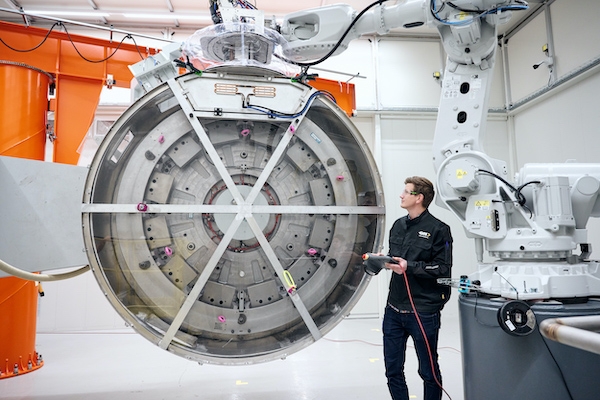
GKN Aerospace boostes its commitment to sustainable manufacturing, with a £50 million (600 million SEK) investment in its cutting-edge additive fabrication technology in Trollhättan, Sweden. The Swedish Energy Agency’s Industriklivet initiative will fund £12 million (152 million SEK) of this investment, which will help to revolutionise production methods by reducing raw material usage by up to 80%. The technology will be embedded at GKN Aerospace's Trollhättan facility in Sweden, and will be operational later in 2024.
Joakim Andersson, president of GKN Aerospace’s Engines business, commented: “We are committed to driving sustainability in the aviation industry and pioneering improved solutions for our customers. Our development of additive fabrication for large, complex and load-bearing aircraft components is a great example of this and it marks a significant breakthrough for the industry. The benefits we see from this technology are truly game-changing. Government support has been pivotal in enabling us to push our capabilities forward and I am delighted to establish this unique technology in our world-leading facility in Trollhättan Sweden."
Currently, aircraft engine components rely on large castings and forgings, with up to 80% of the material machined away before reaching the final form. By employing additive technology, which involves layer-by-layer construction using metal wire or powder fused together with lasers, GKN Aerospace is able to minimise raw material waste, energy use and shipping within production. This significantly cuts emissions, costs and lead time.
GKN Aerospace has been at the forefront of additive fabrication for almost two decades, and has significant research and technology centres in Sweden, the UK and the US. Thanks to the backing from Industriklivet, the new additive production centre in Sweden is projected to create around 150 new job opportunities for operators, technicians, and engineers at the Trollhättan facility.
Peter Engdahl, Head of Research, Innovation and Business Development at the Swedish Energy Agency said: “GKN Aerospace's solution will be able to contribute to a reduced use of raw materials and create opportunities to fundamentally change the design, making the aircraft engine lighter and more efficient. This is the first time this technology is being tested for this component size and we see the potential for it to spread globally and also in other areas.”
The Board of Directors of Costruzioni Aeronautiche Tecnam S.p.A. has unanimously appointed Giovanni Pascale Langer as Chief Executive Officer, while Paolo Pascale Langer, who...
NetJets is elevating its premium ground experience with the introduction of new exclusive-use private terminals at Dallas Love Field (DAL), Washington Dulles International Airport (IAD) and Colorado&r...
Embraer and LATAM Airlines Group have signed a Component Pool Program agreement to support the airline's introduction of 24 Embraer E195-E2 aircraft. In addition to the firm order, LATAM retains o...
Marking a significant industry milestone, Garmin has delivered its 1,000th G1000 integrated flight deck retrofit for a King Air aircraft. The program has helped redefine cockpit modernizatio...

