



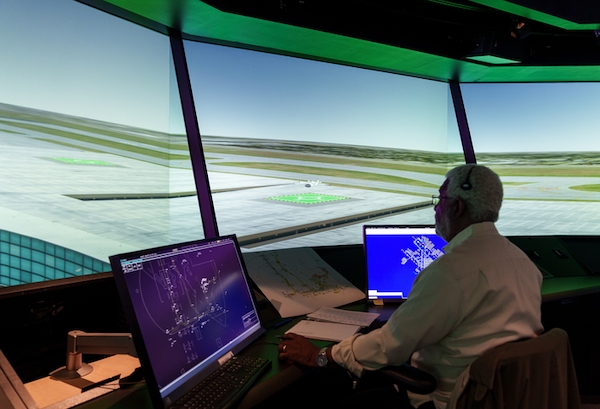
Joby Aviation has successfully completed a series of air traffic simulations with NASA’ Ames Research Center that evaluated how air taxi operations can be integrated into today’s airspace, including at busy airports, using existing air traffic control tools and procedures. The simulations, jointly developed by Joby and NASA airspace engineers following a multi-year airspace study, tested scenarios with dozens of eVTOL aircraft per hour flying into and out of the complex, busy airspace in the Dallas-Fort Worth region using today’s airspace system.
Tom Prevot, Air Taxi Product Lead at Joby, commented: “Working alongside our NASA colleagues, we have now demonstrated in a real-world simulation how air taxi operations can take place in today’s airspace system, alongside active airport traffic, using tools and procedures currently available to air traffic controllers. These successful simulations were made possible by years of careful planning and collaboration between two organizations committed to redefining what is possible, and we’re proud to be paving the way towards the scaled commercialization of air taxis in the National Airspace System.”
The activity took place at NASA Future Flight Central, a high-fidelity virtual tower facility offering a 360-degree view of a real-time simulation of an airport, where a team of NASA and Joby engineers, as well as pilots and air traffic controllers, simulated traffic patterns at Dallas Love Field (DAL) and DFW airports, representative of complex and busy airspace.
During the simulation, participating teams of controllers virtually tested the ability to integrate up to 120 eVTOL operations – arrivals or departures – per hour from DFW’s Central Terminal Area, alongside the airport’s existing traffic. Up to 45 simulated eVTOL aircraft were simultaneously aloft in DFW’s Class B airspace during the activity.
Following scenarios developed by NASA and Joby airspace engineers, participating controllers employed some of the highly-structured routes and procedures used today in busy low-altitude airspace regions, including Letters of Agreement and dedicated controller positions to scale air taxi operations without impacting existing traffic.
NASA and Joby engineers hosted representatives from the FAA and the National Air Traffic Controllers Association to observe the simulation. More details on the simulation are available on NASA’s website and NASA will publish a complete analysis of the simulation results next year, sharing data with the industry and the FAA.
International air charter specialist Chapman Freeborn has joined BlackBook Motorsport, the global business network connecting key stakeholders across Formula 1, NASCAR, MotoGP and the wider internatio...
Viasat, a global leader in satellite communications, has enhanced its JetXP business aviation connectivity service with a simplified three-tier plan structure and, for the first time, publis...
From Learjets and Challengers to turboprops such as the Pilatus PC-12, different aircraft bring different capabilities to a medical flight. Sebastian Demiet, COO of MTI 24/7, explains why aircraft sel...
The Board of Directors of Costruzioni Aeronautiche Tecnam S.p.A. has unanimously appointed Giovanni Pascale Langer as Chief Executive Officer, while Paolo Pascale Langer, who...

