



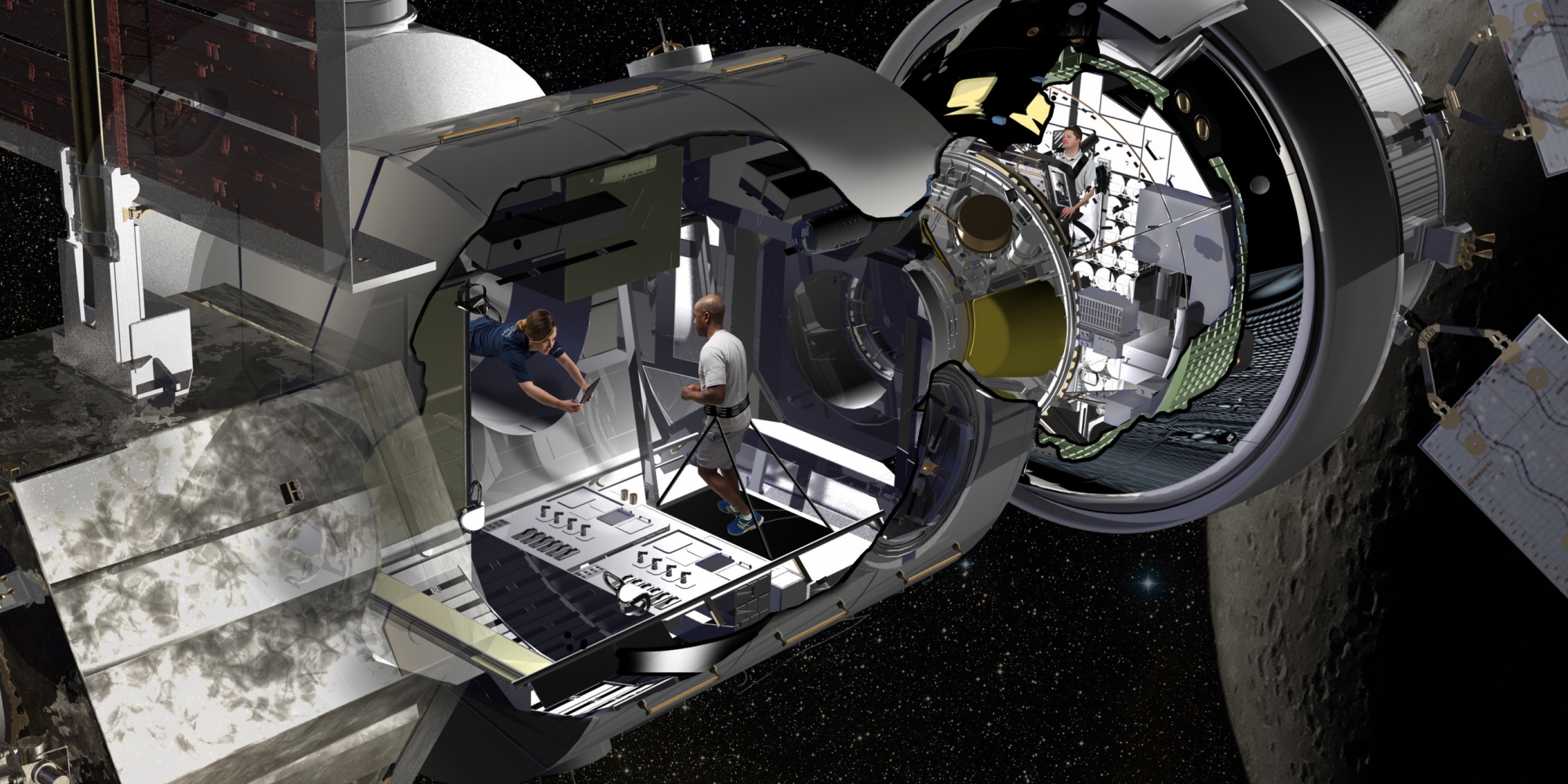
Refurbishing a shuttle-era cargo container used to transfer cargo to the International Space Station, Lockheed Martin (NYSE: LMT) is prototyping a deep space habitat for NASA at Kennedy Space Center. This prototype will integrate evolving technologies to keep astronauts safe while onboard and operate the spacecraft autonomously when unoccupied.
Under a public-private partnership, NASA recently awarded Lockheed Martin a Phase II contract for the Next Space Technologies for Exploration Partnerships (NextSTEP) habitat study contract. As part of Phase II, the team will continue to refine the design concept developed in Phase I and work with NASA to identify key system requirements for the Deep Space Gateway. Included in this work, the team will build a full-scale habitat prototype in the Space Station Processing Facility at NASA's Kennedy Space Center and a next-generation deep space avionics integration lab near Johnson Space Center.
"It is easy to take things for granted when you are living at home, but the recently selected astronauts will face unique challenges," said Bill Pratt, Lockheed Martin NextSTEP program manager. "Something as simple as calling your family is completely different when you are outside of low Earth orbit. While building this habitat, we have to operate in a different mindset that's more akin to long trips to Mars to ensure we keep them safe, healthy and productive."
A full-scale prototype of the deep space habitat will be built by refurbishing the Donatello Multi-Purpose Logistics Module (MPLM). Donatello was one of three large modules, flown in the space shuttle payload bay, that were used to transfer cargo to the International Space Station. The team will also rely heavily on mixed reality prototyping using virtual and augmented reality. Through this approach, the team can reduce cost and schedule, as well as identify and solve issues early in the design phase.
"We are excited to work with NASA to repurpose a historic piece of flight hardware, originally designed for low Earth orbit exploration, to play a role in humanity's push into deep space," said Pratt. "Making use of existing capabilities will be a guiding philosophy for Lockheed Martin to minimize development time and meet NASA's affordability goals."
The work will occur over 18 months and will build upon the concept study performed in Phase I. Phase II will also focus on mixed reality and rapid prototyping, and working on concept refinement and risk reduction. The new results, which will be provided to NASA, will further the understanding of the systems, standards and common interfaces needed to make living in deep space possible.
The Deep Space Gateway will rely on many of Orion's advanced capabilities that can be used while astronauts are there, and utilizes capabilities common to Lockheed Martin-built planetary spacecraft like Juno and MAVEN while it's unoccupied. Employing NASA's space-proven Orion spacecraft as the Deep Space Gateway command deck early on allows for a safe and practical approach for the incremental build-up of deep space exploration capabilities.
Additionally, Lockheed Martin will build a Deep Space Avionics Integration Laboratory in Houston to demonstrate command and control between the Deep Space Gateway and Orion. The lab will help reduce risk associated with critical data interfaces between Deep Space Gateway elements and provide an environment for astronauts to train for various mission scenarios.
"Because the Deep Space Gateway would be uninhabited for several months at a time, it has to be rugged, reliable and have the robotic capabilities to operate autonomously. Essentially it is a robotic spacecraft that is well-suited for humans when Orion is present," said Pratt. "Lockheed Martin's experience building autonomous planetary spacecraft plays a large role in making that possible."
Phenix Jet Cayman has added a Bombardier Global 8000 to its managed fleet, successfully completing the aircraft's CAACI registration transfer and entry into service in less than five business days...
The Board of Directors of Costruzioni Aeronautiche Tecnam S.p.A. has unanimously appointed Giovanni Pascale Langer as Chief Executive Officer, while Paolo Pascale Langer, who...
When a vehicle assembly line is at risk of running out of critical components, every minute of downtime carries a significant cost. In many cases, an emergency air charter is not the expensive option,...
EVIA AERO and Fabspace Hangars are addressing one of aviation’s most pressing infrastructure challenges: the shortage of hangar capacity across Europe. Through their partnership, EVIA AERO now o...

