



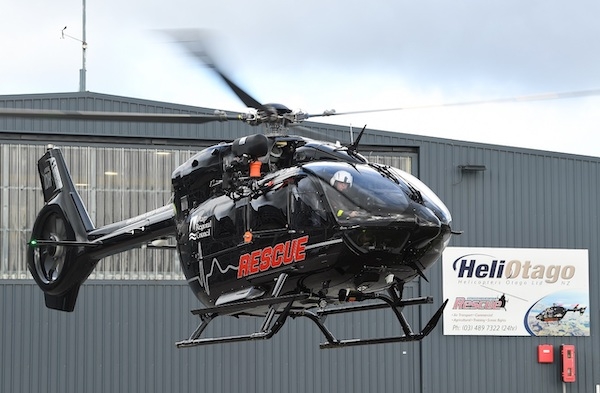
In a ceremony at the GCH Aviation Group headquarters, Airbus has tdelivered two H145 helicopters to the New Zealand Helicopter Emergency Medical Services
Airbus Australia Pacific Managing Director Andrew Mathewson said these were the first two H145 helicopters in emergency medical services (EMS) configuration in the New Zealand market.
“I’m proud that Airbus’ helicopters are providing vital medical services and assisting the communities between Christchurch and Dunedin operated by New Zealand Helicopter Emergency Services.
“We at Airbus are privileged to work alongside local stakeholders, and play our part in supporting such lifesaving aeromedical operations, as the country grows its focus on this industry.
“A key design factor of the H145 helicopter is to be able to configure the helicopter to provide medical and rescue operations for specialised emergency services.
“This multi-purpose helicopter is tailored for emergency medical services and law enforcement duties, along with aerial work, passenger transport - including private and business aviation - and offshore operations. For multi-mission operators, the H145 can be reconfigured for different roles quickly and easily.

“Designed to deliver excellent performance throughout the flight, the H145 offers capability and flexibility, especially in conditions where the aircraft is operating at high altitude and where time is of the essence,” he said.
The H145 is the market leader for emergency medical services and rescue missions, thanks to its well-established HEMS heritage with its BK117 and EC145 predecessors. The quietest in its class and equipped with state-of-the-art Helionix avionics suite, this twin engine helicopter offers exceptional performance along with upgraded main and tail rotor systems. This guarantees an unprecedented level of performance in both hover and one-engine inoperative conditions.
The Fenestron technology brings benefits such as improved flight and ground safety to customers, as well as reduced power demand in forward flight, and lower sound and vibration levels. Included in the Fenestron is a redesigned tail gearbox that contributes to lower maintenance costs. It incorporates a duplex tail rotor actuator and dual hydraulic circuits – installed in a new damage-tolerant all-composite tail boom.
With a global fleet of more than 1,400 helicopters of the H145 family, the fleet has accumulated more than five million flight hours. In New Zealand alone, there are currently 41 H145 family of helicopters deployed for aeromedical, search-and-rescue, utility and business aviation purposes.


Bombardier will return to the 2026 NBAA Business Aviation Convention & Exhibition with a showcase that highlights the company's flagship aircraft, award-winning customer support network and di...
Airbus has secured 21.J Civil Design Organisation Approval from Australia’s Civil Aviation Safety Authority (CASA), marking a significant milestone for its local operations and enhancing its abi...
Phenix Jet Cayman has added a Bombardier Global 8000 to its managed fleet, successfully completing the aircraft's CAACI registration transfer and entry into service in less than five business days...
Airbus forecasts that demand for aviation services will more than double between 2026 and 2045, exceeding US$420 billion in value. Driven by a compound annual growth rate (CAGR) of 3.8%, the sector wi...

