




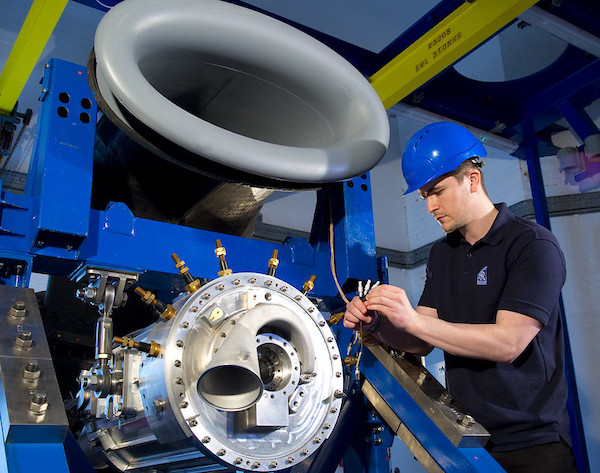
Rolls-Royce has started testing the first elements of the most powerful hybrid-electric aero power and propulsion system in aerospace at a newly-renovated testbed. The tests are part of the 2.5 megawatt (MW) Power Generation System 1 (PGS1) demonstrator programme, for future regional aircraft.
Rolls-Royce has begun testing the AE2100 engine element and specialist controls and thermal management system, supported by a system integration generator, at our Testbed 108 in Bristol, UK.
Later this year a fully operational generator and a 3,000-volt power electronics system, currently completing testing at our facility in Trondheim, Norway, will be brought together to start full PGS1 system testing. The generator can be used either for hybrid-electric propulsion systems or as part of a “more-electric” system for larger aircraft.
PGS1 forms an important element of our sustainability strategy, which includes developing innovative electrical power and propulsion systems, as well as further improving gas turbine performance and promoting the use of Sustainable Aviation Fuels.
Alan Newby, Director Aerospace Technology and Future Programmes, Rolls-Royce, said: “This is an important milestone for us all at Rolls-Royce. We are bringing together a system that promises to be truly ground-breaking in the world of aviation. We know that in a post COVID-19 world people will want to connect but do so more sustainably. Electrification offers a new way to power short-haul aircraft and we want to be at the forefront of pioneering this technology.
“Our PGS1 tests will lead the way in finding out what this new generation of hybrid-electric propulsion system is capable of delivering. For example, our generator is about the size of a beer keg but it needs to produce enough electricity to power around 2,500 homes and do so continuously. By doing these tests we will be able to validate our digital modelling and find out precisely what is physically and technically possible.”

Once ground tested, PGS1 will then provide a technology basis for any future hybrid aircraft programme requiring MW power.
Both Testbed 108 and PGS1 have been supported by the UK Aerospace Technology Institute’s MegaFlight project, while the 2.5MW electrical generator, motor and power electronics design, make and testing in Trondheim has been supported by the EU Clean Sky 2 programme.
Testbed 108 has a history that relates to a number of iconic aircraft engines. They include:
1960s /’70s - Hercules and Centaurus engines which powered the Bristol Beaufighter, Bristol Brabazon and Hawker Sea Fury aircraft. Olympus engine that powered the Concorde supersonic jet aircraft and the Avro Vulcan.
1970s/’80s - Pegasus and RB199 engines, powering the Harrier and Tornado.
1990s - Gem and RTM322 that power the Lynx, Army Air Corps Apache and Royal Navy Merlin helicopters.
The testbed, which had been used as a storage facility from 2008, was completely renovated to accommodate hybrid-electric testing.
From Learjets and Challengers to turboprops such as the Pilatus PC-12, different aircraft bring different capabilities to a medical flight. Sebastian Demiet, COO of MTI 24/7, explains why aircraft sel...
Airbus forecasts that demand for aviation services will more than double between 2026 and 2045, exceeding US$420 billion in value. Driven by a compound annual growth rate (CAGR) of 3.8%, the sector wi...
EVIA AERO and Fabspace Hangars are addressing one of aviation’s most pressing infrastructure challenges: the shortage of hangar capacity across Europe. Through their partnership, EVIA AERO now o...
Information Design One AG, the Frankfurt-based aviation technology company behind the aFuel platform, has achieved a major operational milestone. During the first half of 2026, aFuel processed 50...

