



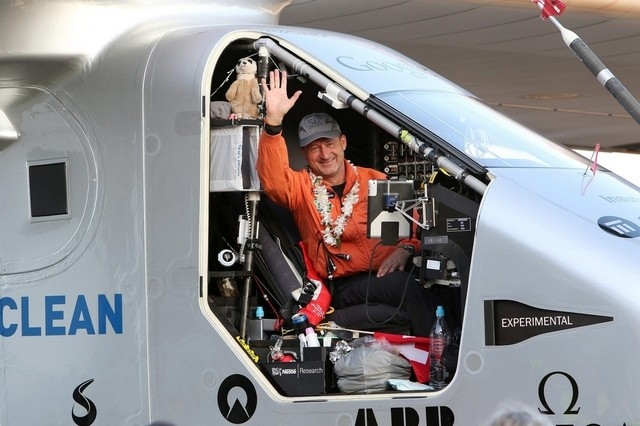
He taps the plane on the side before boarding.
“When I think about it, I become a little emotional,” said the pilot of the record-setting Solar Impulse 2, Andre Borschberg.
“We are now again in the preparation mode, with the objective to come back to Abu Dhabi.”
The Swiss national said all efforts are being made to see that the plane completes its voyage to Abu Dhabi after its unplanned hiatus in Hawaii, setting a seal on a new world record.
Solar Impulse 2 took off from the capital on March 9 and its crew aims to complete the circumnavigation of the Earth by returning to the UAE this summer using only sunlight for power.
If the mission succeeds, it will be the first round the world flight made without fossil fuels and a big boost to raising awareness of renewable energy.
“Coming back to Abu Dhabi, it will feel like returning home, where we have a lot of friends and I think it will be a great moment. It will not be easy because there are a lot of things yet to be done,” he said.
The mission stalled when Solar Impulse suffered a battery malfunction on its longest leg, across the Pacific from Japan to Hawaii in July.
“It wasn’t a technical issue per se,” Mr Borschberg said. “In fact, what happened during the five-day, five-night flight, was I took to a mission profile that I was not meant for.”
On June 29, Mr Borschberg, supported by co-pilot Bertrand Piccard and the team in Monaco, was given the go-ahead to attempt the 7,212 kilometre journey, the success of which would set a new world record for longest solo flight yet.
On the first day, engineers at mission control centre detected a malfunction in the autopilot alarm system.
Mr Borschberg and Mr Piccard practised for years to sleep in 20-minute bursts, the only time they have for rest in a plane that has only one pilot.
During those 20 minutes, the pilot would activate the autopilot and rest knowing that if the plane were to malfunction, they would be awoken by the alarm.
The malfunction meant that the crew could not sleep for five days.
Nonetheless, they found a workaround, but the big issue happened on the second day. Before the cross-Pacific attempt, the Japanese aviation authority denied them approval for a test flight.
Without time to charge the batteries, Mr Borschberg had to start the trip and expose the plane’s 17,000 solar cells to its fuel – the Sun. That required two very battery-intensive ascents, which are uncharacteristic of the flight plan.
“The following five-day flight put too much stress, and that is the reason we had to change the batteries,” said Mr Borschberg.
Upon landing in Hawaii, the trip was a success but “irreversible” damage was done to the plane, leaving it grounded for six months.
During that time, with help from the €20 million (Dh80.7m) raised to make improvements, the team manufactured new batteries which they expect to install in the coming weeks before testing in February and early March. They plan on taking off in mid-April, he said.
“When I spent five days, five nights in the aeroplane, it became my home, the office, almost a companion if I could put it his way, we both helped each other and you develop an emotional relationship, I’m excited to go back,” he said.
Airbus forecasts that demand for aviation services will more than double between 2026 and 2045, exceeding US$420 billion in value. Driven by a compound annual growth rate (CAGR) of 3.8%, the sector wi...
Bombardier will return to the 2026 NBAA Business Aviation Convention & Exhibition with a showcase that highlights the company's flagship aircraft, award-winning customer support network and di...
AEE Aircraft Electronic Engineering GmbH and Horizon Aircraft have joined forces to integrate advanced avionics capabilities into the Cavorite X7 hybrid-electric eVTOL programme. Throug...
Deutsche Aircraft is advancing the next chapter of regional aircraft manufacturing in Europe with the construction of a new production facility at Leipzig/Halle Airport. To support the site's...

