


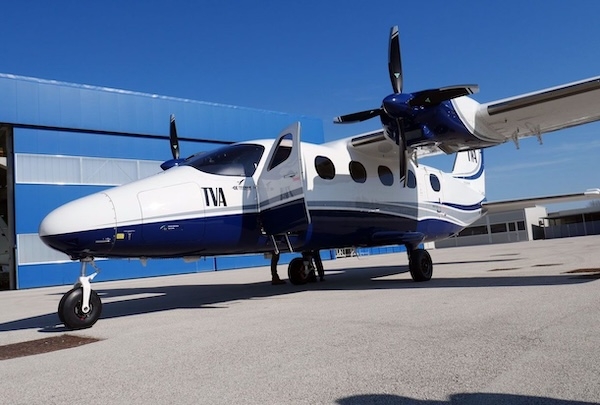
The Tennessee Valley Authority is demonstrating the real-world value of the Tecnam P2012 Special Mission Platform (SMP), which has become a vital tool for monitoring and maintaining its extensive power transmission network. In a report aired by WKRN News 2 Nashville on October 14, TVA's aviation and transmission teams highlighted how the aircraft serves as an “eye in the sky” across more than 16,000 miles of transmission lines, helping make maintenance operations faster, safer and more cost-effective.
Equipped with a high-performance LiDAR laser scanner capable of surveying more than three acres of terrain per second, the P2012 SMP also carries four cameras that capture detailed imagery along every mile of TVA's transmission network. The collected data enables transmission foresters to quickly identify vegetation encroachment and other potential hazards, allowing maintenance crews to be dispatched precisely where action is needed.
Francesco Sferra, Tecnam P2012 - Special Mission Platforms Sales & Business Development Manager, commented:““Special mission operators don’t buy flight hours, they buy data, and what matters is how much quality data each dollar delivers. TVA’s experience says it better than any brochure: the data quality of a helicopter survey, collected faster, from a safer altitude and at a much lower operating cost. The P2012 SMP was conceived as an affordable twin-engine platform with the payload, power and stability to carry LiDAR and camera systems all day long. We are proud to see TVA’s teams turning that capability into real savings for the communities they serve.”
TVA Aviation Manager Phil Kanagy, who previously flew the same survey missions in helicopters, explained that while helicopters remain extremely useful for getting in and out of tight places, their operating costs are 75% higher than those of the airplane: “We’re able to collect the data much faster than before, much cheaper than before, and at a higher altitude than we were with helicopters,” Kanagy told WKRN. Flying higher also makes the missions much safer for his crew.
TVA surveyor Robert Byrd, whose job has moved from field equipment to GPS and now to airborne LiDAR over the past 20 years, recalled working “forty hours a week, hot or cold, snakes, ticks, chiggers” in the field. According to TVA Transmission Forester Matthew Townsend, work that used to take his team months now takes about 15 to 20 minutes. “Saves us a lot of time, a lot of money, and it saves us from any potential heat stress, snake bites, anything like that that could hurt us out in the field.”
TVA’s aerial inspection program, fully deployed in 2025 following five years of research and development, relies on the Tecnam P2012 SMP to conduct annual surveys of more than 5,000 miles of transmission lines as part of its vegetation management strategy. A two-pilot crew can inspect approximately 450 miles of infrastructure per day, a dramatic increase compared with the roughly five miles covered by a ground crew. This enhanced efficiency enables TVA to identify potential threats more quickly while helping ensure reliable electricity delivery to the 10 million people it serves.
The mission is precisely what the Tecnam P2012 SMP was designed for. Powered by twin Lycoming TEO-540-C1A piston engines featuring electronic engine controls, the aircraft delivers efficient performance at the low and medium altitudes typically required for aerial survey operations, consuming approximately 31 U.S. gallons of fuel per hour. Its design includes two ventral hatches and ample onboard electrical power, simplifying the integration of advanced mission equipment such as LiDAR scanners and multi-camera systems. In addition, twin-engine redundancy enhances operational safety, allowing crews to conduct missions with confidence over forests, mountainous terrain and densely populated areas.

TARMAC Aerosave has set a new industry benchmark by becoming the first company in the world to secure Aircraft Fleet Recycling Association (AFRA) accreditation across all three scopes of aircraft disa...
Cirrus Aircraft is celebrating the 10th anniversary of its Collier Trophy-winning Vision Jet at NBAA-BACE 2026, marking a decade of innovation that has continuously advanced the world&r...
A Discover Airlines Airbus A330 has become the first Airbus aircraft worldwide to enter regular commercial service after undergoing a full-scale AeroSHARK retrofit, marking a signi...
Samson Sky has enlisted renowned Italian automotive designer Luigi Memola to develop the interior design of its Switchblade Flying Car, bringing world-class automotive styling expertise to the roadabl...